LifeIZGood.com
A place to discover, renew and rejoice
Who do you think you are?
I’ve finally figured out my problem; the reason it’s hard to forge on, dig deep, actually do the thing I need to do, which is figuring out how to write this novel I’ve been pecking away at on and off for months: Drum roll….my problem is….I don’t want to work! And writing, at least fiction writing, is frickn’ hard work.
Blogging, like I’m doing now—talking to the screen, having a conversation with myself—is natural, fun, cleansing, even therapeutic. Journal type writing is chatting with Julie or Eileen over tea and cookies. But writing a novel, well that’s tippy-toe-with-the-big-boys-and-girls Mount Rushmore-literary-idols writing.
So, when it’s time to open my laptop and tinker with words and ideas crafted the previous day, every single time, I come to one, and only one, conclusion: My writing sucks.
“Who the hell do you think you are to try and be a novelist at your age?” my shoulder-sitting, devil-horned critic whispers.
Yada, yada, yada. I know. I know. It’s true, it’s true.
“Give up,” the voice continues. “The world doesn’t need another tortured writer who spends her precious, ever depleting days working on a project that will get ripped apart only to be tossed in a recycle bin and drenched in El Pollo Loco leftovers?”
I totally agree: Life IZ short. “Why,” as Mary Bailey pleads with her newly broke, tormented husband in “It’s a Wonderful Life, “George, must you torture the children?”
Who needs it? Pour a second of glass of wine and enjoy life.
Because, because, because…I have this story in me, and I need to help my protagonist get through some tough stuff, and I’m the only person on this messed up planet who can help her get to the other side. Like a crazy person, I run head-first into the fire of self-doubt as my reverence for true artists blisters in the San Luis Obispo County sun. How do they do it? How do they push aside the demons and nurture their fragile, creative, selves?
I’m in awe, in wonder, of how anything brilliant ever sees the light of day. Because producing meaningful, challenging, work is hard.
I’m not ashamed to admit that ever since I started writing this novel, I’ve been paralyzed with self-loathing. I become a crazy-haired, cave-dweller cast away punishing myself …“until I get it done!!!!!”
It’d be so easy to give up, but then I hear Ray Bradbury’s words to me, “If you want to become a good writer, roll out of bed every morning, sit down, get out of the way, and take dictation from your muse.”
“Oh, and one more thing,” he added, giggling like the grandpa leprechaun that he was, “you’ve got to give up your day job.” A particularly tall order considering, at the time, I was a single parent journalist supporting two children. Still, his words rang true and for 18 years I shared the master storyteller’s wisdom with my 8th grade English Language Arts writers who took his advice to heart and wrote fiction with gusto and flamboyant disregard for rules.
It’s taken 38 years to apply Mr. Bradbury’s truisms to my own writing practice. Sort of. “Help, Mr. Bradbury, help me!” Because it’s not going well. Because even though I no longer have a job or young kids to distract me or a husband to love or a home to fuss over, I still create excuses, like scrolling nonsense on my phone or obsessing over politics or worrying about family members and all the same stuff that used to throw me off track when I was working full time and raising a family. But now my attention span and self-confidence are even worse.
The literary mentors who sit on the bookshelf, John Steinbeck, Mary Oliver, Maya Angelou, Harper Lee, are constant reminders of my inferiority.
“I will never be as good as them,” the voice pokes and prods. “Why even bother? Go have fun.”
I’m having deja vu.
I remember sitting in an open cubicle in the newsroom as colleagues furiously—joyfully—tapped their keyboards, each one an expert, professional, all males, knowing what they were doing, having a plan, producing stories in record time, then joking around with approving editors while I remained hunched over my big ol’ computer trying to find the right way to describe a person’s face or their environment, time of day, gasping for breath, being strangled by deadlines and the unattainable high bar I set for myself to generate something alive, pulsating, and meaningful to readers, while simultaneously tangling my words and agreeing with my ever-present internal banter, “You are a total failure.”
“Barker, it’s time,” an editor would yell across the newsroom for all to hear.
“She’s a fraud,” I imagined my colleagues snickering. “She won’t last a month.”
“Almost, almost,” I’d respond to Frank or Mike or Jon as I did my best to edit my imperfections.
Once, maybe a few times, I wrote a story I was proud of; writing it just about ripped out my heart. When I asked one of my more sensitive colleagues, Alan, whose wife was artistic and French, to read my story and make suggestions, he kindly agreed. I remember walking away from his desk, exhausted from the ordeal of writing, and waiting and waiting for a response.
When he didn’t get back to me, I knew it was a sign; my story was a piece of crap and there was so much wrong with it he didn’t have the heart to tell me face to face.
I took a deep breath and sauntered to Alan’s desk and tapped him on the shoulder; when he turned around, his slender face was flushed and he was wiping his blue, bloodshot eyes. “It’s good,” he said, his voice quivering. “It’s very good.”
Finally, I had nailed it. “Paul’s Last Days”, the story of a family coming to terms with their loved one’s sexual identity and his ultimate death from AIDS, won the National Headliner’s Award and other journalism honors; it was validation that my storyteller instincts were sound. But in journalism there’s an old saying, “You’re only as good as your last headline,” and the grind of producing under chronic deadline pressure makes eloquent writing a rarity. My struggle to craft well-written stories in a timely manner, along with my desire to stay home and raise my younger daughter, clashed; it was a signal for me to change directions.
I freelanced while my baby was a baby and continued to struggle with the struggle of writing. “Why does it take so long? What’s wrong with me?” After a few years freelancing for the Los Angeles Times and other magazines, making little money while taking up too much time, I gave up my side hustle in pursuit of another passion—teaching.
Which brings me to today, retired from two careers, chasing yet another dream at 68 years old. When I look back and think about it, it’s all been hard—-raising children, being married, remodeling my old house, changing careers, making healthy choices. One of the reasons, I think, is because I set the bar high. I’ve always been this way, whether it was creating Barbie’s dream house out of found materials, being the head high school cheerleader and pushing our squad to perform our best, working my ass off as a single parent and earning straight A’s in college or pushing myself to earn a Master’s in Education while teaching and challenging students to reach their potential. I can’t help it. Hard work is in my DNA. Which brings me back to the subject of this blog: The Ugly Side of Creativity: P-R-O-C-R-A-S-T-I-N-A-T-O-N.
Websters defines this pathetic, self-destruction condition as “to put off intentionally and habitually” or “putting off something that needs to be done.” I warned my English Language Arts students of this malady all the time and offered them the following tried and true remedies:
- Set a timer.
- Factor-in breaks
- Create rewards
- Avoid reviewing what you’ve already written. Move on. There will be time to edit later.
- Be willing to trash what you’ve written and start anew or start in the middle or even the end.
- Wait a couple of days, let it percolate, before tackling it again.
Sound advice, if only I’d follow it.
I don’t because I’m here, alone, no worries, no responsibilities, no critics, except myself. No alarm clock. Beautiful environment. Plenty of food. Fuel in the van tank. Family and friends who love me. No expectations from others. Just myself. Myself.
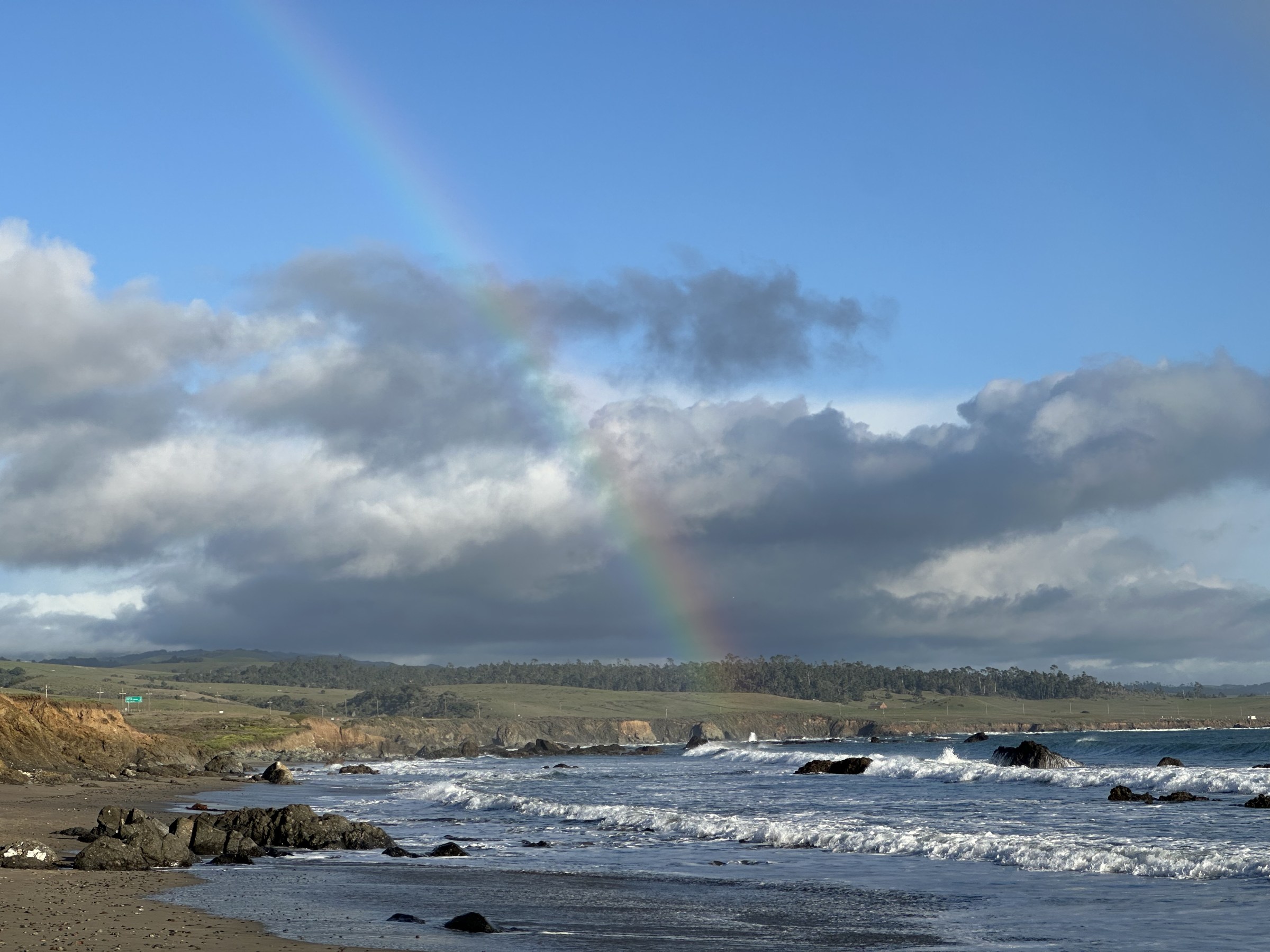
Yesterday as I was trying to shake away the procrastination willies, I decided to follow Tips No. 2 and 3 and reward myself after a day of rewriting one paragraph and go for a walk along the beach. At 3:15, I crawled out of my pajamas, showered, and went for a drive up the coast to one of my favorite beaches, San Simeon State Beach. The skies were brilliant blue, painted with wisps of grey and white clouds. I set the timer and decided, at the very least, to walk for 20 minutes.
As I was strolling along the rain-soaked shore, I noticed I was alone and began to wonder if someone knew something I didn’t, like there was a hurricane forecast or a tsunami warning? I mean, the day was so glorious, where were the people? Then, I looked up: a very bruised black cloud was directly above me whereas everywhere else was post-rain bright blue and crisp cotton white.
I continued to walk, a bounce in my step, realizing being away from the laptop was just the antidote I needed. I was enjoying life, freedom—-to hell with the black cloud—-when these sweet little, tiny kisses of rain began to fall. I kept walking toward my intended destination, “No big deal, this is cool,” picked up some rocks, gazed at the ocean, when the drops got thicker and more consistent.
Hmm, maybe I should turn around since I don’t feel like getting drenched. I assessed the black cloud that seemed to be following me and figured that I could outpace it if I turned around started sprinting south, which I did.
“Ah HA, cloud, take that!” I said out loud, then looked directly ahead; beyond the pier, cradled in the lush green hillside, was a pot of gold, a rainbow, that I, apparently, was the only person—on the entire planet—to see.
As is the case with all rainbows, if you miss the moment, you miss the moment, so I decided, instead of jogging to try to meet the rainbow’s origin, I’d slow down, take a photo, and simply enjoy.
I am in the midst of metaphors. The sandy footprints, the crashing waves and mirrored stretch of sea, the light and dark clouds, the rain, and its bow. This, this moment, is The Point. My job isn’t that of a writer. My job is to pay attention. Record. Writing, painting, dancing, singing, which I do every day, loud and proud, are celebrations, recollections, orchestrations, my best attempt to capture The Now and make some kind of sense of it.
It’s no wonder I fail. It’s no wonder I struggle because the miraculous, extraordinary, ordinary profundities of Life can’t fit on a page or a single photograph. It’s all too big and too small to understand why we’ve been gifted such wonders.
But we artists continue to try. We gather shells and stones and handfuls of sand and place them in saucers and fill drinking glasses with wildflowers that we collect on our walks, unconscious, playful, metaphoric reminders of relationships near and far.
Do I, or my words, matter? Nature suggests that’s not the point.
Nor is getting junked up and colon tangled with dumb negativity. There’s only one Truth, one word, one cure for what ails us: Love. It starts from above and radiates through the leaves and the wind and the misty dew that often masks the horizon, duping us into believing that the sun isn’t there and Spring will never arrive.
How does this wangling, bangling, unthreading confession end? By foraging for rainbows. By not taking myself, and what I do or don’t do, too seriously. By taking a friend’s hand and laughing and crying all during the same impromptu lunch without judgment or unprovoked suggestions. By loving, and accepting others as you would love and accept yourself. By being, as one of my other literary mentors, Maya Angelou, put it, “… a rainbow in someone’s cloud.”
Shortly before he died at age 91, dear Ray Bradbury told another mentor who also befriended me when I was a journalist, the late Los Angeles Times columnist Al Martinez, “I wake up every morning with metaphors circling in my head.”
Metaphors, my dear reader, was my problem, what I was missing, the salt and pepper in my secret sauce, why I felt out of my league, why I couldn’t write. Simply, profoundly, I forgot: I am the rock, the river and the tree.
 LifeIZGood.com