LifeIZGood.com
A place to discover, renew and rejoice
For a week I camped in the desert
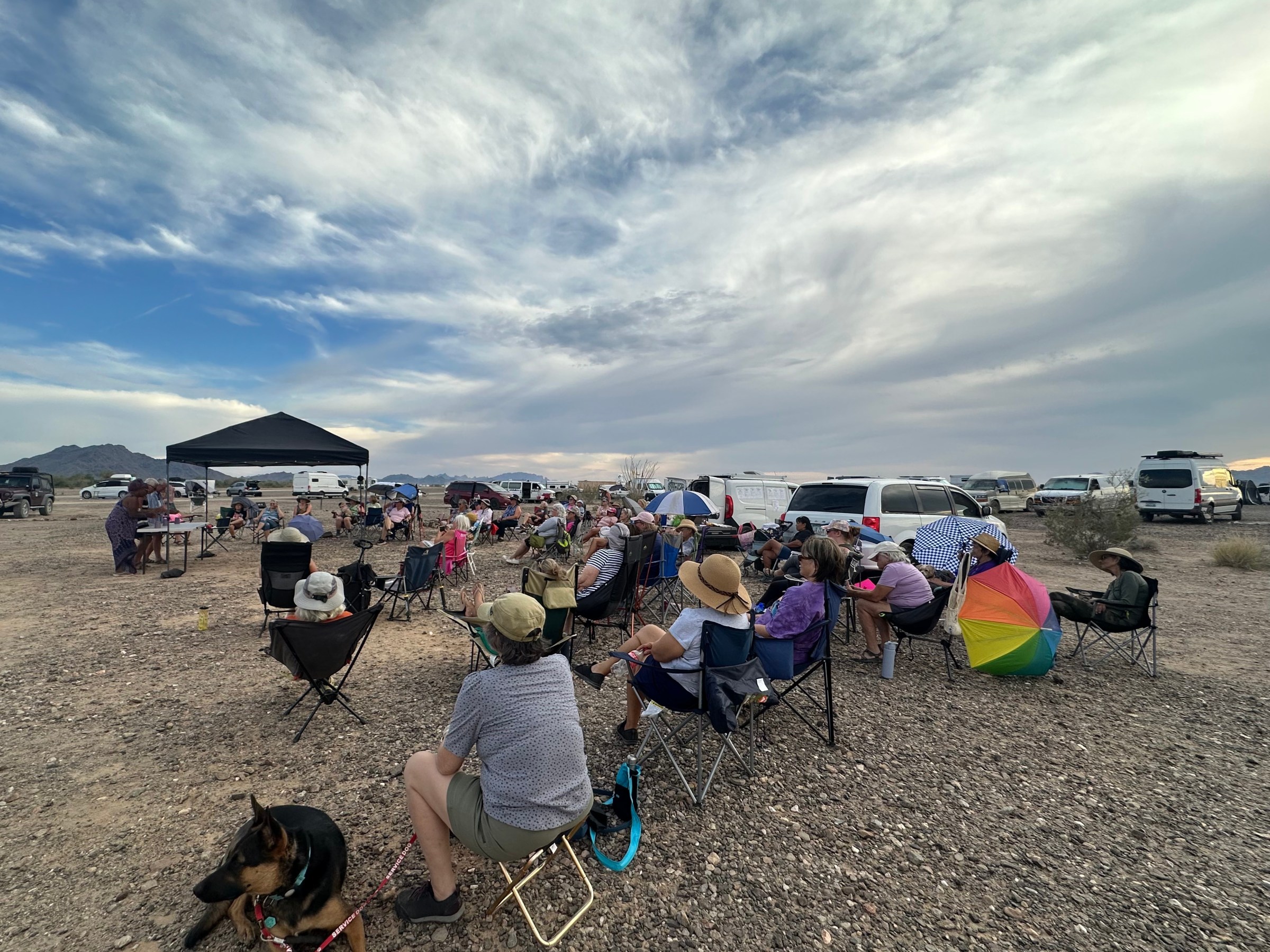
I’m on location. In a setting I thought of visiting, someday—maybe—but nixed the notion because it’s dusty and desert-y and HOT and DRY and really not my vibe at all. But here I am with more than 100 sisters from another mother, celebrating resiliency, growth, adventure, new friendships, dancing, singing, negotiating challenges like the sun and the coyotes and the 5 a.m. rooster alarm clock, all the while embracing the beauty, grace and strength of this eclectic gathering of wise women who have chosen to rejuvenate, reinvent and consequentially, connect with the Divine.
I never expected this.
I never imagined I’d be googly-eyed-enthused meeting a YouTube “star” who says attracting 55k subscribers was never a planned career path. “How could it be?” Lulu said, genuinely surprised by the positive impact her channel has had on women across the world. She created “Lulu’s Way” out of a desire to share her van life discoveries from the perspective of a mature, solo traveling woman, while simultaneously promoting healthy eating, and positivity.
I, like others at the gathering, never expected that one day I’d drive out to Quartzite, Arizona, and meet Lulu and like-minded women who made the decision to seize the day—at this incredible juncture of life—and re-evaluate my choices and ask, “Where do I want to go from here?”
I never knew that taking a chance, trying something new, literally driving in a new direction, would be so impactful.
What was it like attending the “2025 Lulu’s Way Quartzite Meetup”?
Our days were simple. Participation optional. Morning chants, followed by dancing and choral singing, discussions, how-to’s, a Zoom book club chat, a pet parade, a favorite gadget session, a talent/no talent showcase, disco dance parties every night at our neighbor Matt’s Burning Man-esque strobe-light, Desert Dance Club, and lazy, luscious moments of quiet and conversation between new besties.
Throughout the experience, I kept asking myself and others, “How is it possible to make quick friends with women of all ages, sizes, colors, religions, regions, economic and educational backgrounds?” What’s the secret sauce? “It’s Lulu,” everyone agreed. The 67-year-old Massachusetts native, “Lulu sets the tone.”
As a person, and content creator, Lulu is an anomaly. She has no sponsors, no product endorsements, and no agenda other than sharing what works best for her. Lulu’s message is direct and authentic: You are in charge of you. Make the most of this beautiful life. Live it fully. Purely. Celebrate. Be grateful. You be you, she likes to say.
And that’s the draw, that’s why I’m here, parked alongside many, many, many fellow van/sedan/Prius/tent/RV/rented car camper women, a little nervous, way out of my I-prefer-to-be-alone comfort zone, open to a new way of thinking, traveling, and accepting.
My people. My tribe. Gathered in this challenging environment. Drawn together by a sense of curiosity, opportunity, and a hunch that maybe, if I open my mind, something interesting might happen.
And it did.
My niggly, wiggly critical, negative thinking and self-doubt dried up like an ocotillo shrub. My moisture-craving face smiled for an entire week. I felt abundant, giving—free—and wholly myself. No one judged. No one compared. We all encouraged. Embraced. Sang off key. Solved car engine troubles. Shared food. Offered to help carry trash to the dumpster, a 15-minute walk down the dusty road and, like worshippers on Sunday morning, rejoiced as the afternoon temperatures dropped and the ginger sun painted Dome Rock Mountains a chiffon scarf of ombre orange.
For a week, we Lulu Wayers lived in a 1960s, peace, love, Age of Aquarius musical. And while our creature comforts—showers, clean toilets, washing machines, flat screen TVs—were absent, that didn’t stop any of us from having fun, not the lady in a wheelchair camping in a minivan or the 80-year-old grandmother of 20 or 29-year-old Emily who drove to the desert from Wisconsin or Kate from Maine who caravaned with Purple Renee and Singing Sharon, traveling buddies who cultivated an alliance at a prior Lulu’s Way East Coast meet up.
Who does this?
What’s going on? my writer-self asked Lulu and her friend, Laura, in between dance sets.
“If you can figure it out,” Lulu said, her toothy grin as bright as the Christmas lights illuminating the newly raked sand dance floor, “let us know.”
Here’s my take:
Women, especially after we’ve raised children, retired from jobs that may or may not have been fulfilling, are often discarded or overly relied upon as caretakers and fixers of everyone else’s problems. Life can take its toll. But, when we decide to do what serves us best rather than placing others’ needs before our own, that pivotal decision is liberating. And, when you’re with other women also in the process of, or having arrived at, self-love and acceptance, that nurturing, supportive, been-there-done-that vulnerability is not only life-affirming, but quenches a longing to shed life’s burdens and, like a newly hatched butterfly, celebrate our true selves.
For a week I camped in the desert with a tribe of mothers, grandmas, aunties, sisters, cousins and friends, and as the days went on, the dust and the rocks of Quartzite, Arizona transformed into a Field of Dreams occupied by mentors and heroes, the names of which you’ll never know. But their stories and faces, laughter and tears, nestled into my parched soul, offering me courage and strength for the road ahead.
Poet Sarah Browning expresses what it feels like “When the Sun Returns” in her beautiful poem.
it is hallelujah time,
the swallows tracing an arc
of praise just off our balcony,
the mountains snow-sparkling
in gratitude.
Here is our real life—
a handful of possible peonies
from the market—
the life we always intended,
swallow life threading
the city air with
our weaving joy.
Are we this simple, then
to sing all day — country songs,
old hymns, camp tunes?
We even believe
the swallows keeping time.
The Flying Machine
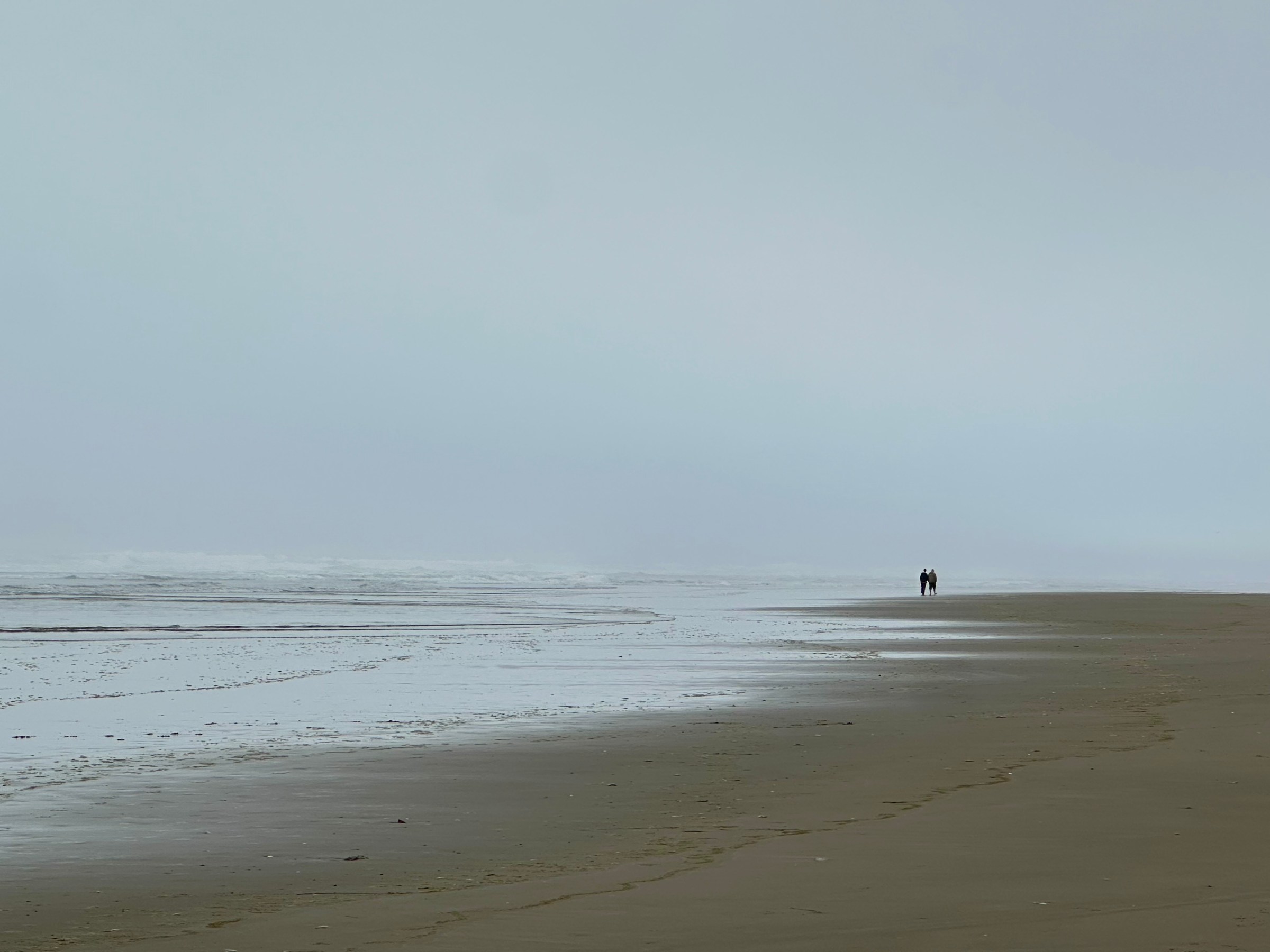
I’m a silly girl. A woman-girl growing inside her own womb, punching, kicking, absorbing nutrients, feeling excited, worried, and at peace, trusting that my caretaker-self won’t let her little girl down, has her best interest at heart, and would do anything to support, heal, comfort and reassure her beloved silly self.
“It’s all going to be OK.”
This journey. This journey called LIFE. A fellow camper dropped by my glorious campsite here at Cape Lookout, Oregon, and complimented my razzle dazzle, hippy-ish set design: melon-colored prayer flags, flame-like solar hanging lights, hammock chair and my sweet Mercedes Sprinter, to which I thanked her, then offered an explanation, “Whenever I’m settled for more than a few days, I put up the flags to create a boundary of peace.”
“Yeh, we need it, for sure, right now,” she agreed.
We chatted a bit. “Where did you get the flags?” she asked.
“Oh, I’ve had them a long time. I used to drape them in my classroom.” They were an inspiration for a project I did one year. At the start of the school year, I’d give students a piece of white cloth and we’d make our own flags designed with metaphors that represented our inner core and values.
“I’d lace the flags across the windows, and they became our sun catchers,” I said, elaborating, “I told students, ‘Whenever you feel challenged or lost, look at the symbols in your flag and remember who you are on the inside, your true self. ‘ ”
The story struck my camp neighbor, Kimberly, who placed her hand on her chest. She said she wished she’d been in my 8th grade English Language Arts class, then volunteered, “I’m on a healing journey.”
“Me too!” I replied. She smiled then introduced me to her companion, Connie, and her wee russet brown poodle, Russell.
“Can I take a photo of your flags?” she asked. “The spirals have a special meaning to me.”
“Of course,” I said of my faded flags, which I’ve traveled with for a decade. Odd, but until my camp neighbor mentioned it, I’d never noticed the spirals at the beginning and end of the strand: the first spiral is complete with variations of red, while the other, green and blue, is partially highlighted indicating “in process”.
“What does the spiral mean to you?” I asked.
“A path to healing,” she said, explaining that in her experience, growth is often painful. “People say healing is like taking one step forward and two steps back. But I believe it’s more like a side-to-side shuffle, stepping off the path to pause and reflect, before getting back on the road.”
“That’s crazy, I was just writing about that,” I shared, holding up my journal.
“There are no coincidences,” Connie affirmed.
“Can I share something that happened to me yesterday?” I asked.
“Please,” they said in unison.
I was journaling. Spiraling—my definition—as I often do, writing about my worries, fears, my desire to help loved ones, only to dead-end, realizing my limitations. “Once and for all,” I wrote, “I need to get a bolt cutter and cut the chains that keep weighing me down.” I had just put a period at the end of the sentence when I heard a strange buzzing sound in the sky.
Understand that this campground, other than the roaring ocean and symphony of flying ducks, squawking blue jays and melodic, red-breasted blackbirds, is exceptionally quiet. In my five days here, I have yet to hear a jet, boombox or obnoxious citified sound.
So, to hear a sound in the sky was unusual.
I looked up, like the servant in Ray Bradbury’s short story, “The Flying Machine”, and witnessed the master storyteller’s words come to life: A winged, engine-powered, giant kite was soaring above the ragged Pacific Northwest coastline. The pilot was free. Unchained. Focused on the beauty, the exhilaration of flight.
The sight was fleeting, too quick to get a clear photo.
“Did you see it?” I asked my camp neighbors.
“We heard something but didn’t look up.”
“It might sound silly, but I think it was a sign’” I said.
“No coincidences,” Kimberly said, “you were meant to see that.”
“Don’t let fear stop you,” Connie said, offering her interpretation of the sighting.
One might think, “You’re retired, what do you have to worry about?” Aren’t you dancing on the sand dunes, light, airy, an endless stream of money flowing out of your pockets, fit, stealth, rich in conversation, possessions, in your pursuit of happiness, unencumbered, open, the world is your oyster kind of thing?
Sometimes.
While I’m the same silly girl I’ve always been albeit bigger-waisted and saggier-skinned, I’ve acquired a lot of baggage along the way, patterns, habits, that I’m constantly reviewing and shedding. My current Me-Growth Project is to be more mindful and travel with a lightness of being. As such, I’m striving …
to be intentional,
to sleep as long or as little as I wish,
to avoid rushing,
to embrace silence and conversation,
to dismiss anger,
to focus on the good in people,
and dance in the moonlight with the shimmering dragonflies
as I journey in my unapologetic gypsy home, decorated with twinkling lights, tiny pumpkins, Fall leaves, talisman rocks, shells, and textured pillows stuffed with all the clothes I own. I carry too much, it’s true. It’s my nature, my habit. But I’m learning to discard the things and feelings that no longer serve me. According to my new camp acquaintance, Kimberly, the process continues, “Until our final day on Earth.”
I like that notion.
If you never read Bradbury’s short story—-spoiler alert—-the Emperor murders the enthused pilot/inventor because he fears the impact future Flying Machines will have on his kingdom. The ramifications of fear are powerful: On one hand it motivated the pilot to soar, while his nemesis viewed flight as a threat. The Emperor thought he won by silencing his enemy. But turns out, fear ultimately trapped the ruler in a sealed globe of his own making. In the end, the Emperor could not control the inevitable.
Bradbury’s cautionary tale gave me something to ponder as I absorbed the blessed fragments of the Pacific Northwest sun and wondered if the rumble I just felt was the predicted platonic earthquake and 15-minutes-to-escapeTsunami or my Apple Watch reminding me, “Time to move.” I stepped into the labyrinth, as my technological travel partner instructed, and did as I was told. Enjoy the gift of life every single precious, complicated moment.
My Side of the Mountain
“The Secret Garden”
“Tom Sawyer”
“A Present for the Princess”
“My Side of the Mountain”
Disney’s “Sleeping Beauty”, “Snow White”, “The Wizard of Oz” and Dad’s soothing, animated voice lulling me to sleep, assuring me that all is well in the world and that he, my tanned knight in a bleached T-shirt, will protect me from the ghosts that hijacked my slumber.
Escape. Discovery. Freedom. Imagination. The little girl singing in the forest, painting river rocks, wading in the cool creek, hunting for salamanders and maple leaf boats. Taking off in her covered wagon with her clanging iron pans and flour sacks full of provisions.
That was me then. That is me now. Surrounded by pixie dust.
Is it everything I imagined, this life as a pioneer woman? Yes, even better. The rain-soaked moss is softer, the greens are greener, the tickling creek is giddier, and my redwood tree forest home is cozier than I ever envisioned.
To live a dream I tenderly carried since I was 4, playing make-believe in the cottage Dad built when The Barkers lived on Spreckles Lane, is comforting, uplifting, peaceful, joyful, but the description that best suits this connect-the-dots, full circle experience, is meant to be.
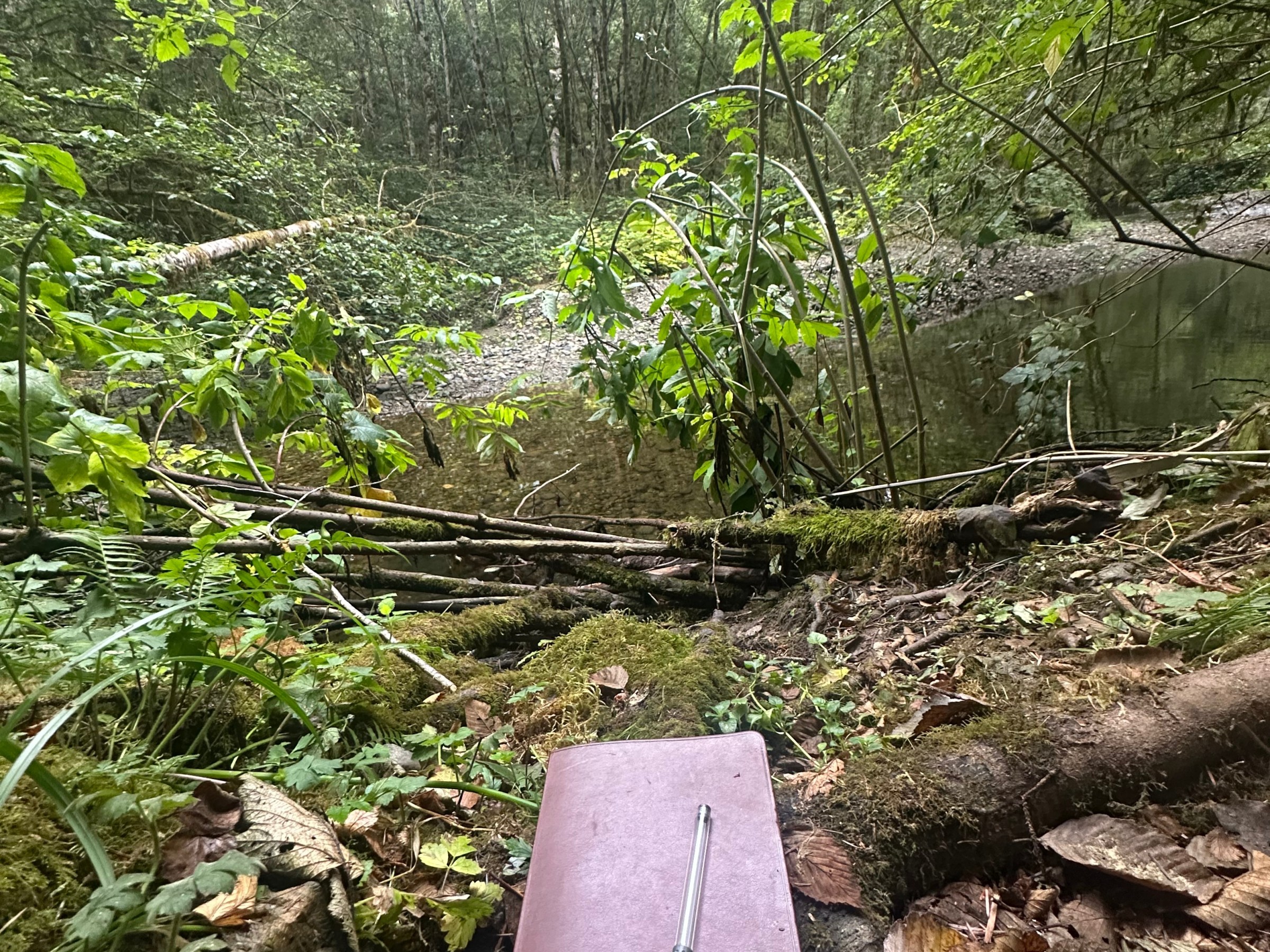
This, I know to be true: The script I am living was written long before I was born. It’s taken all these years, all the mistakes, recalculations, the yes’s and no’s, jumbles and rumbles and grumbles, to land me in this exact spot along the bank of Prairie Creek with my book, cup of lukewarm Trader Joe’s coffee, and laptop, to chronicle and celebrate gratitude.
I am a little girl in a 69-year-old body.
All my left and right turns, the tears and embraces, dwell inside this strong and fragile clay vessel. The spirit I arrived with, even before my conception, remains the same: I am the sum total of all my experiences, which I can recall and conjure in an instant, inspired by a photo or sensory reminder.
I am a Girl Scout, thumbing my blue G.S. Guidebook to the pages about camping, unlatching the scratched aluminum mess kit, pretending that dirt, leaves and ocean pebbles are really steaming canned chili.
I am ginger Lorraine’s next door neighbor, sitting in the Johnson’s VW camper van pretending to put my Chatty Cathy daughter to bed.
I am racoon tail-capped Davy Crockett traversing through the ferns, doing my best to throw Native American-killing colonists off my trail.
I am the forest. Reaching toward heaven. Lush with anticipation. Anxious for Fall.
I am a symphony of green.
A ranger told me last night before the campfire program after I gushed my euphoria about being surrounded 24/7 by green, that humans are the only species who can distinguish variations of green.
“All other animals,” Ranger Brett said, “just see green.”
Oh, us complicated, longing-to-define, humans.
True enough. When inept me tries to describe this curtain, these drapes, this furniture, this ceiling, this carpet of camouflage, my limited vocabulary turns Crayola crayon—-pine, grass, Spring, Army, lime, moss, sea foam—I realize it’s simply not possible, not in words, not in photos, not in watercolor, to capture, to preserve, this feeling of green, which, by the way, I tried to do when I visited my first-ever forest, Sequoia National Park, when I was in the fourth grade and Mom let me organize and plan a family vacation; I took a plastic tub from Smart and Final and tried to net the Sierra Nevada Mountain air. Two things about that experience: First, empower kids to plan family trips, and two, heed that inner longing, the thing you know you need to do, but keep postponing, and just do it. Because. Green is turning rusty orange. Then it’s gone, mulched back to where it began.
Here, by this gurgling, playful creek, sans deadlines, schedules and lack, these words, these wispy ribbons of crepe paper, surface: when you want for nothing, you have everything.
Oh yeah, that’s right. I forgot. Again.
I tumble into a leaf canoe and float toward the sea, docking, when it feels right, into a mermaid cove, where I can play, take a nap, have a picnic, meet up with friends, read a book, paint, write or sing off key. Too much to do in a single day or was it a thousand seconds? On my side of the mountain, one never knows.
Oh, the Places You’ll Go
“Every time my surroundings change, I feel enormous sadness. It’s not greater when I leave a place tied to memories, grief or happiness. It’s the change itself that unsettles me, just as liquid in a jar turns cloudy when you shake it.” ~ Italo Svevo
That’s it. That’s why being settled (and knowing that I’m not) means so much to me at this juncture of life, the day of my 69th birthday.
Upon review, I’ve been rattling, moving, growing, caring for, caring about, feeling inspired, being stunned by the calamity of The Times, for as long as I can remember.
Every action has a reaction.
Being in one place for a period of weeks, answering the call of my inner voice, is what my soul needed. I didn’t know how bruised I was until I stopped and wrapped myself in stillness.
In this healing refuge, I need not achieve anything beyond the simplicity of daily life; a walk along the beach, a circle around my hilly neighborhood, the thought of a nap (which I never do, but often think of), reading and writing time, a bit of gardening, drumming, ukelele-ing, dancing and afternoon water-coloring on my shady deck.
A full life. A simple life.
Turbulent peace.
Even as a transplant retiree, living a hundred miles from the rat race, there are always things to do, not chores (although even as a single person there are bits and pieces to clean up), but hobbies I’ve never had time to pursue, and thoughts I wish to ponder.
Like …
the green curtain of oak trees that embrace my wee cottage by the sea have eyes engraved in the bark; natural cracks exposed in the trunk, chiseled by wind and the blue jays. While I live alone, my brother trees and sister birds and grandmother ocean sing to me all day long. They have no reason to raise their voices. Their whispers are like a silk ribbon caressing my cheek, reassuring me that their spirit dwells within me, whether I linger here or go elsewhere.
Change is in forecast. I wish it not, but clouds are gathering.
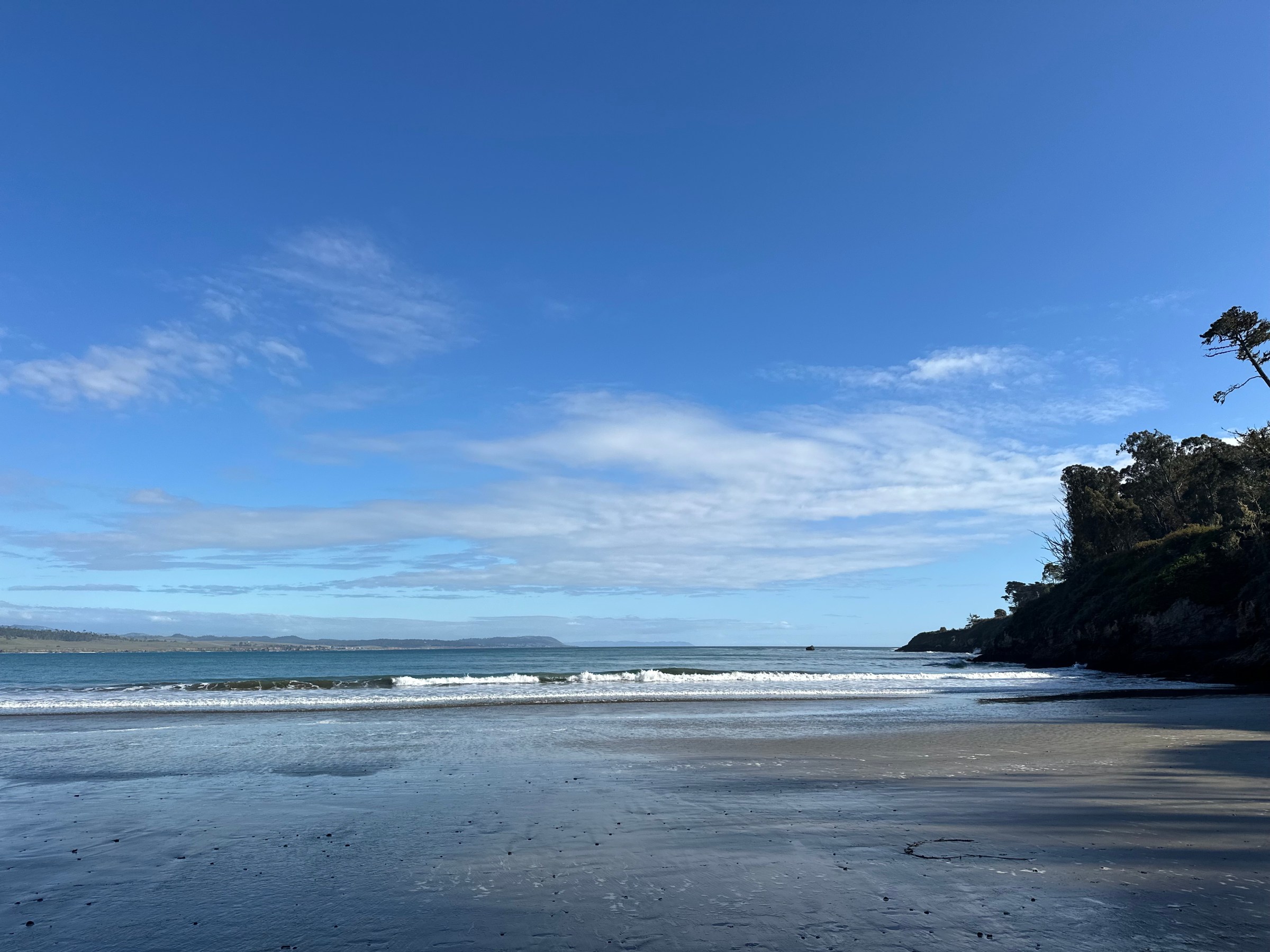
Until then, I collect experiences the same as I collect heart rocks along San Simeon State Beach shore.
Earlier tonight, I flirted with Giovanni, the talented Italian chef here in town. It’s been a long while since I batted my eyes at a stranger. But it was Giovanni’s porcini fettucine. And the Italian wine. And the bottle(s) of Champagne my new friends and I consumed as we watched the roaring sea. And it was my birthday, nudging precariously close to a daunting decade, that caused me to reconsider love.
This new love of my life, he would have to be pasta.
He would have to be wine.
He would have to allow me to take his face in my hands and kiss him on the forehead and walk away with no regrets. Which is what happened. When I turned 69.
I’m learning, and often failing, to trust the process, grab the ring, enjoy the journey, and all the other cliché truisms. It’s hard not knowing where I’ll be and for how long?
My current rental looks like it’ll be more temporary than I thought. I was in the process of hunkering down and nesting for possibly a year, but change is a’brewing. Yet another reminder to remain light on my feet and flexible of thought, a mantra I apparently need to be reminded of often because like everyone else, I have no idea when or how my story ends. Uncertainty, I’m discovering, is an opportunity for me to open my heart to new possibilities, kind of like the Class of 2025 is experiencing as they close out their senior year.
In thinking about my nephew’s upcoming high school graduation, and my last graduating former students, I recently re-read Dr. Seuss’s “Oh, the Places You’ll Go” with a new set of eyes. Seuss wrote the poem in 1990 and died a year later at 87. While most of us associate the poem with school promotion, often gifting the illustrated classic to young ones, Seuss’ words apply to anyone at any stage of life; all of us are in the transition process. Which is comforting, when you think about it; we are all fragile beings searching for certainty in uncertain times, making our relationship with one another all the more vital and precious.
“Oh, the Places You’ll Go” By Dr. Theodore Seuss
Congratulations!
Today is your day.
You’re off to Great Places!
You’re off and away!
You have brains in your head.
You have feet in your shoes.
You can steer yourself
in any direction you choose.
You’re on your own. And you know what you know.
And YOU are the guy who’ll decide where to go.
You’ll look up and down streets. Look ’em over with care.
About some you will l say, “I don’t choose to go there.”
With your head full of brains and your shoes full of feet,
you’re too smart to go down any not-so-good street.
And you may not find any
you’ll want to go down.
In that case, of course,
you’ll head straight out of town.
It’s opener there,
in the wide open air.
Out there things can happen
and frequently do
to people as brainy
and footsy as you.
And when things start to happen,
don’t worry. Don’t stew.
Just go right along.
You’ll start happening too.
Oh, the places you’ll go!
You’ll be on your way up!
You’ll be seeing great sights!
You’ll join the high fliers
who soar to great heights.
You won’t lag behind, because you’ll have the speed.
You’ll pass the whole gang and you’ll soon take the lead.
Wherever you fly, you’ll be best of the best.
Wherever you go, you’ll top all the rest.
Except when you don’t.
Because, sometimes, you won’t.
I’m sorry to say so
but, sadly, it’s true
that Bang-ups
And Hang-ups
can happen to you.
You can get all hung up
in a prickle-ly perch.
And your gang will fly on.
You’ll be left in a Lurch.
You’ll come down from the Lurch
with an unpleasant bump.
And the chances are, then,
that you’ll be in a Slump.
And when you’re in a Slump,
you’re not in for much fun.
Un-slumping yourself
is not easily done.
You’ll come to a place where the streets are not marked.
Some windows are lightened. But mostly they are dark.
A place you could sprain both your elbow and your chin!
Do you dare to stay out? Do you dare to go in?
How much can you lose? How much can you win?
And IF you go in, should you turn left or right…
Or right-and-three-quarters? Or, maybe, not quite?
Or go around back and sneak in from behind?
Simple it’s not, I’m afraid you will find,
for a mind-maker-upper to make up his mind.
You can get so confused
that you’ll start in to race
down long wiggled rocks at a break-necking pace
and grind on for miles across weirdish wild space,
headed, I fear, toward a most useless place.
The Waiting Place…
…for people just waiting.
Waiting for a train to go
or a bus to come, or a plane to go
or the mail to come, or the rain to go
or the phone to ring, or the snow to snow
or waiting around for a Yes or No
or waiting for their hair to grow.
Everyone is just waiting.
Waiting for the fish to bite
or waiting for the wind to fly a kite
or waiting around for Friday night
or waiting, perhaps, for their Uncle Jake
or a pot to boil, or a Better Break
or a string of pearls, or a pair of pants
or a wig with curls, or Another Chance.
Everyone is just waiting.
NO!
That’s not for you!
Somehow you’ll escape
all that waiting and staying
You’ll find the bright places
where the Boom Bands are playing.
With banner flip-flapping,
once more you’ll ride high!
Ready for anything under the sky.
Ready because you’re that kind of a guy!
Oh, the places you’ll go! There is fun to be done!
There points to be scored. There are games to be won.
And the magical things you can do with that ball
will make you the winning-est winner of all.
Fame! You’ll be famous as famous can be,
with the whole wide world watching you win on TV.
Except when they don’t.
Because, sometimes, they won’t.
I’m afraid that some times
you’ll play lonely games too.
Games you can’t win
’cause you’ll play against you.
All Alone!
Whether you like it or not,
Alone will be something
you’ll be quite a lot.
And when you’re alone, there’s a very good chance
you’ll meet things that scare you right out of your pants.
There are some, down the road between hither and yon,
that can scare you so much you won’t want to go on.
But on you will go
though the weather be foul.
On you will go
though your enemies prowl.
On you will go
though the Hakken-Kraks howl.
Onward up many
a frightening creek,
though your arms may get sore
and your sneakers may leak.
On and on you will hike.
and I know you’ll hike far
and face up to your problems
whatever they are.
You’ll get mixed up, of course,
as you already know.
You’ll get mixed up
with many strange birds as you go.
So be sure when you step.
Step with care and great tact
and remember that Life’s
a Great Balancing Act.
Just never forget to be dexterous and deft.
And never mix up your right foot with your left.
And will you succeed?
Yes! You will, indeed!
(98 and ¾ percent guaranteed)
KID, YOU’LL MOVE MOUNTAINS!
So…
be your name Buxbaum or Bixby or Bray
or Mordecai Ali Van Allen O’Shea,
you’re off to great places!
Today is your day!
Your mountain is waiting.
So…get on your way!
I Wrote a Poem

It’s been a long while since I blogged. I have so much to share and don’t really know where or how to begin. It’s all good. No worries there. But it’s been a jumble, a rumble, an unfolding, a sorting out—-literally—-of my entire life and beyond. And as I unpack the pieces of time lost and found, I wrote this poem inspired by a painting my landlord, Penny Fitzgerald, created called “Yellow Dog”. Penny’s illustration, I believe, is for sale, in case it speaks to you as it did me. Her contact info is: https://www.instagram.com/pennyfstudio/
Both words and picture are featured in this month’s Cambria Center for the Arts Show.
A Life Long Considered
By Janet Barker
She left a life
she knew
For a life she’d long considered,
with her yellow dog,
a ceramic yellow mixing bowl,
haphazardly packed in her often-unreliable yellow van,
canopied beneath the blistering Central Valley yellow sun.
It was a day she could have just as easily turned around
and returned to the almost-empty storage unit,
where she’d carefully stack two dozen see-through bins containing yellowed images of a life mostly well lived
back when her world was the yellow house,
with the yellow wheelbarrow, geographically centered in the city of her beginnings,
close to work,
close to family,
close to every memory she ever had—
her three children times 48 years,
grandchildren, friends, ex-husband, extended family,
chickens, rabbits, cats, a turtle,
a pond full of goldfish, a guest egret, and her beloved pups,
Tahoe, Maggie, Bailey and Monet.
Tears clouded the woman’s vision as she drove past her childhood home, the school she attended and once taught at, and the 100-year-old beach cottage she salvaged and saved.
“Thank you,” she cried to everything and everyone who had led her to this moment
leaving behind, taking with,
on the road
to the next chapter
with Yellow Dog, who wagged her modest tail as the woman
cranked up 1970s tunes and bobsledded down the 46
through watercolor hills toward the misty, cauliflower sea.
“Is this heaven?” she asked her yellow companion.
“It is,” Yellow Dog assured, before disappearing into the pearly stones,
only to one day meet again.
Who do you think you are?
I’ve finally figured out my problem; the reason it’s hard to forge on, dig deep, actually do the thing I need to do, which is figuring out how to write this novel I’ve been pecking away at on and off for months: Drum roll….my problem is….I don’t want to work! And writing, at least fiction writing, is frickn’ hard work.
Blogging, like I’m doing now—talking to the screen, having a conversation with myself—is natural, fun, cleansing, even therapeutic. Journal type writing is chatting with Julie or Eileen over tea and cookies. But writing a novel, well that’s tippy-toe-with-the-big-boys-and-girls Mount Rushmore-literary-idols writing.
So, when it’s time to open my laptop and tinker with words and ideas crafted the previous day, every single time, I come to one, and only one, conclusion: My writing sucks.
“Who the hell do you think you are to try and be a novelist at your age?” my shoulder-sitting, devil-horned critic whispers.
Yada, yada, yada. I know. I know. It’s true, it’s true.
“Give up,” the voice continues. “The world doesn’t need another tortured writer who spends her precious, ever depleting days working on a project that will get ripped apart only to be tossed in a recycle bin and drenched in El Pollo Loco leftovers?”
I totally agree: Life IZ short. “Why,” as Mary Bailey pleads with her newly broke, tormented husband in “It’s a Wonderful Life, “George, must you torture the children?”
Who needs it? Pour a second of glass of wine and enjoy life.
Because, because, because…I have this story in me, and I need to help my protagonist get through some tough stuff, and I’m the only person on this messed up planet who can help her get to the other side. Like a crazy person, I run head-first into the fire of self-doubt as my reverence for true artists blisters in the San Luis Obispo County sun. How do they do it? How do they push aside the demons and nurture their fragile, creative, selves?
I’m in awe, in wonder, of how anything brilliant ever sees the light of day. Because producing meaningful, challenging, work is hard.
I’m not ashamed to admit that ever since I started writing this novel, I’ve been paralyzed with self-loathing. I become a crazy-haired, cave-dweller cast away punishing myself …“until I get it done!!!!!”
It’d be so easy to give up, but then I hear Ray Bradbury’s words to me, “If you want to become a good writer, roll out of bed every morning, sit down, get out of the way, and take dictation from your muse.”
“Oh, and one more thing,” he added, giggling like the grandpa leprechaun that he was, “you’ve got to give up your day job.” A particularly tall order considering, at the time, I was a single parent journalist supporting two children. Still, his words rang true and for 18 years I shared the master storyteller’s wisdom with my 8th grade English Language Arts writers who took his advice to heart and wrote fiction with gusto and flamboyant disregard for rules.
It’s taken 38 years to apply Mr. Bradbury’s truisms to my own writing practice. Sort of. “Help, Mr. Bradbury, help me!” Because it’s not going well. Because even though I no longer have a job or young kids to distract me or a husband to love or a home to fuss over, I still create excuses, like scrolling nonsense on my phone or obsessing over politics or worrying about family members and all the same stuff that used to throw me off track when I was working full time and raising a family. But now my attention span and self-confidence are even worse.
The literary mentors who sit on the bookshelf, John Steinbeck, Mary Oliver, Maya Angelou, Harper Lee, are constant reminders of my inferiority.
“I will never be as good as them,” the voice pokes and prods. “Why even bother? Go have fun.”
I’m having deja vu.
I remember sitting in an open cubicle in the newsroom as colleagues furiously—joyfully—tapped their keyboards, each one an expert, professional, all males, knowing what they were doing, having a plan, producing stories in record time, then joking around with approving editors while I remained hunched over my big ol’ computer trying to find the right way to describe a person’s face or their environment, time of day, gasping for breath, being strangled by deadlines and the unattainable high bar I set for myself to generate something alive, pulsating, and meaningful to readers, while simultaneously tangling my words and agreeing with my ever-present internal banter, “You are a total failure.”
“Barker, it’s time,” an editor would yell across the newsroom for all to hear.
“She’s a fraud,” I imagined my colleagues snickering. “She won’t last a month.”
“Almost, almost,” I’d respond to Frank or Mike or Jon as I did my best to edit my imperfections.
Once, maybe a few times, I wrote a story I was proud of; writing it just about ripped out my heart. When I asked one of my more sensitive colleagues, Alan, whose wife was artistic and French, to read my story and make suggestions, he kindly agreed. I remember walking away from his desk, exhausted from the ordeal of writing, and waiting and waiting for a response.
When he didn’t get back to me, I knew it was a sign; my story was a piece of crap and there was so much wrong with it he didn’t have the heart to tell me face to face.
I took a deep breath and sauntered to Alan’s desk and tapped him on the shoulder; when he turned around, his slender face was flushed and he was wiping his blue, bloodshot eyes. “It’s good,” he said, his voice quivering. “It’s very good.”
Finally, I had nailed it. “Paul’s Last Days”, the story of a family coming to terms with their loved one’s sexual identity and his ultimate death from AIDS, won the National Headliner’s Award and other journalism honors; it was validation that my storyteller instincts were sound. But in journalism there’s an old saying, “You’re only as good as your last headline,” and the grind of producing under chronic deadline pressure makes eloquent writing a rarity. My struggle to craft well-written stories in a timely manner, along with my desire to stay home and raise my younger daughter, clashed; it was a signal for me to change directions.
I freelanced while my baby was a baby and continued to struggle with the struggle of writing. “Why does it take so long? What’s wrong with me?” After a few years freelancing for the Los Angeles Times and other magazines, making little money while taking up too much time, I gave up my side hustle in pursuit of another passion—teaching.
Which brings me to today, retired from two careers, chasing yet another dream at 68 years old. When I look back and think about it, it’s all been hard—-raising children, being married, remodeling my old house, changing careers, making healthy choices. One of the reasons, I think, is because I set the bar high. I’ve always been this way, whether it was creating Barbie’s dream house out of found materials, being the head high school cheerleader and pushing our squad to perform our best, working my ass off as a single parent and earning straight A’s in college or pushing myself to earn a Master’s in Education while teaching and challenging students to reach their potential. I can’t help it. Hard work is in my DNA. Which brings me back to the subject of this blog: The Ugly Side of Creativity: P-R-O-C-R-A-S-T-I-N-A-T-O-N.
Websters defines this pathetic, self-destruction condition as “to put off intentionally and habitually” or “putting off something that needs to be done.” I warned my English Language Arts students of this malady all the time and offered them the following tried and true remedies:
- Set a timer.
- Factor-in breaks
- Create rewards
- Avoid reviewing what you’ve already written. Move on. There will be time to edit later.
- Be willing to trash what you’ve written and start anew or start in the middle or even the end.
- Wait a couple of days, let it percolate, before tackling it again.
Sound advice, if only I’d follow it.
I don’t because I’m here, alone, no worries, no responsibilities, no critics, except myself. No alarm clock. Beautiful environment. Plenty of food. Fuel in the van tank. Family and friends who love me. No expectations from others. Just myself. Myself.
Yesterday as I was trying to shake away the procrastination willies, I decided to follow Tips No. 2 and 3 and reward myself after a day of rewriting one paragraph and go for a walk along the beach. At 3:15, I crawled out of my pajamas, showered, and went for a drive up the coast to one of my favorite beaches, San Simeon State Beach. The skies were brilliant blue, painted with wisps of grey and white clouds. I set the timer and decided, at the very least, to walk for 20 minutes.
As I was strolling along the rain-soaked shore, I noticed I was alone and began to wonder if someone knew something I didn’t, like there was a hurricane forecast or a tsunami warning? I mean, the day was so glorious, where were the people? Then, I looked up: a very bruised black cloud was directly above me whereas everywhere else was post-rain bright blue and crisp cotton white.
I continued to walk, a bounce in my step, realizing being away from the laptop was just the antidote I needed. I was enjoying life, freedom—-to hell with the black cloud—-when these sweet little, tiny kisses of rain began to fall. I kept walking toward my intended destination, “No big deal, this is cool,” picked up some rocks, gazed at the ocean, when the drops got thicker and more consistent.
Hmm, maybe I should turn around since I don’t feel like getting drenched. I assessed the black cloud that seemed to be following me and figured that I could outpace it if I turned around started sprinting south, which I did.
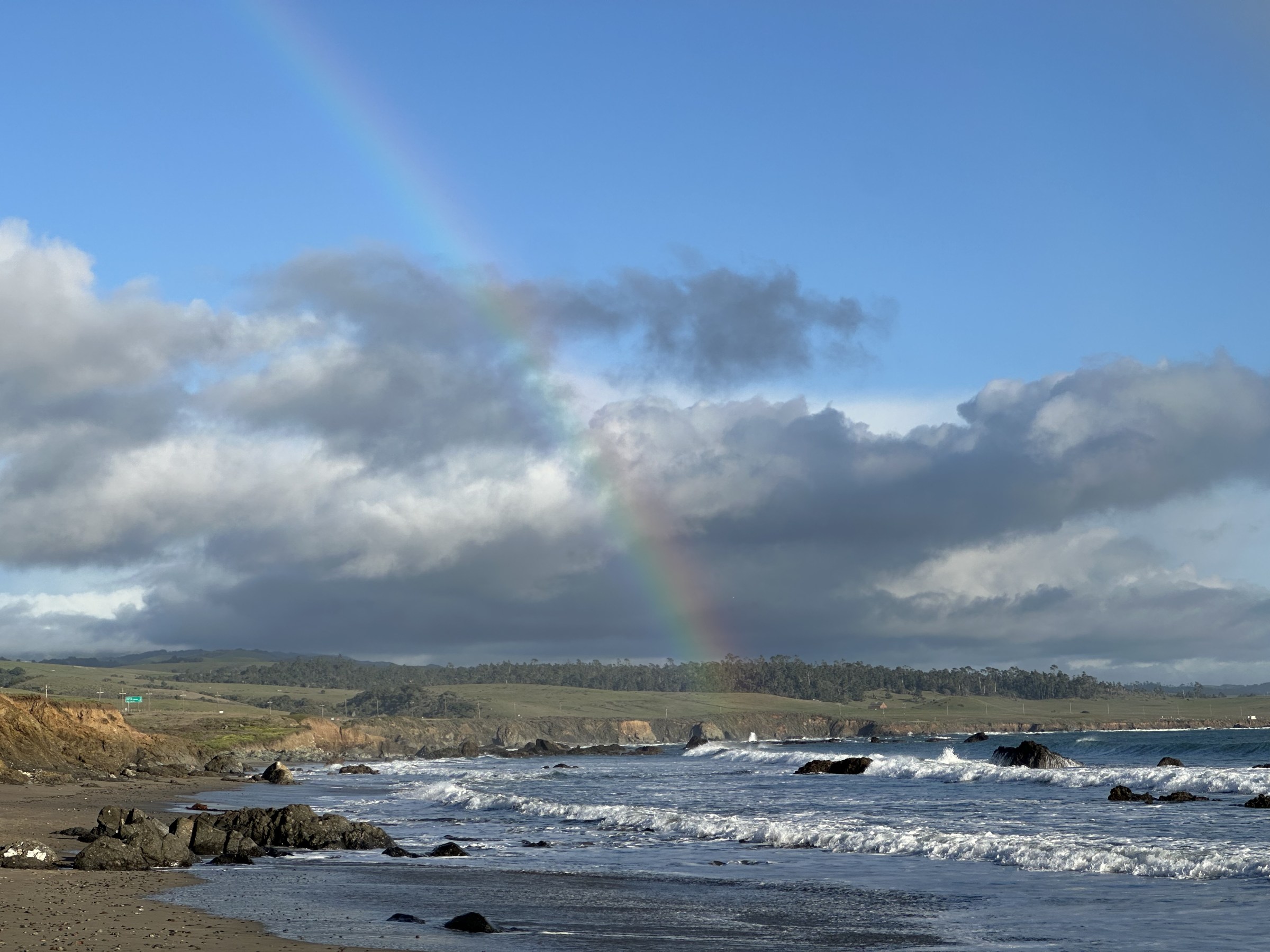
“Ah HA, cloud, take that!” I said out loud, then looked directly ahead; beyond the pier, cradled in the lush green hillside, was a pot of gold, a rainbow, that I, apparently, was the only person—on the entire planet—to see.
As is the case with all rainbows, if you miss the moment, you miss the moment, so I decided, instead of jogging to try to meet the rainbow’s origin, I’d slow down, take a photo, and simply enjoy.
I am in the midst of metaphors. The sandy footprints, the crashing waves and mirrored stretch of sea, the light and dark clouds, the rain, and its bow. This, this moment, is The Point. My job isn’t that of a writer. My job is to pay attention. Record. Writing, painting, dancing, singing, which I do every day, loud and proud, are celebrations, recollections, orchestrations, my best attempt to capture The Now and make some kind of sense of it.
It’s no wonder I fail. It’s no wonder I struggle because the miraculous, extraordinary, ordinary profundities of Life can’t fit on a page or a single photograph. It’s all too big and too small to understand why we’ve been gifted such wonders.
But we artists continue to try. We gather shells and stones and handfuls of sand and place them in saucers and fill drinking glasses with wildflowers that we collect on our walks, unconscious, playful, metaphoric reminders of relationships near and far.
Do I, or my words, matter? Nature suggests that’s not the point.
Nor is getting junked up and colon tangled with dumb negativity. There’s only one Truth, one word, one cure for what ails us: Love. It starts from above and radiates through the leaves and the wind and the misty dew that often masks the horizon, duping us into believing that the sun isn’t there and Spring will never arrive.
How does this wangling, bangling, unthreading confession end? By foraging for rainbows. By not taking myself, and what I do or don’t do, too seriously. By taking a friend’s hand and laughing and crying all during the same impromptu lunch without judgment or unprovoked suggestions. By loving, and accepting others as you would love and accept yourself. By being, as one of my other literary mentors, Maya Angelou, put it, “… a rainbow in someone’s cloud.”
Shortly before he died at age 91, dear Ray Bradbury told another mentor who also befriended me when I was a journalist, the late Los Angeles Times columnist Al Martinez, “I wake up every morning with metaphors circling in my head.”
Metaphors, my dear reader, was my problem, what I was missing, the salt and pepper in my secret sauce, why I felt out of my league, why I couldn’t write. Simply, profoundly, I forgot: I am the rock, the river and the tree.
The Three Bears
For those who have never lived on their own, might be afraid, anxious about silence, worried about fixing things, the idea of cooking for one, being responsible for paying one’s bills—-don’t be. You can do it. You can handle it. I know because not that long ago I used to be fearful, but now realize that the more I step out of my comfort zone, the stronger I get.
I’ve discovered in the last 2.8 years since being retired from my important and all-consuming work as an 8th grade English Language Arts teacher, that being alone isn’t lonely. It’s exuberant. I can dance, read, write, create art, watch binge shows whenever I feel like it with no one to answer to or debate. I have no one but myself to clean up after. I can crack myself up, and do—often.
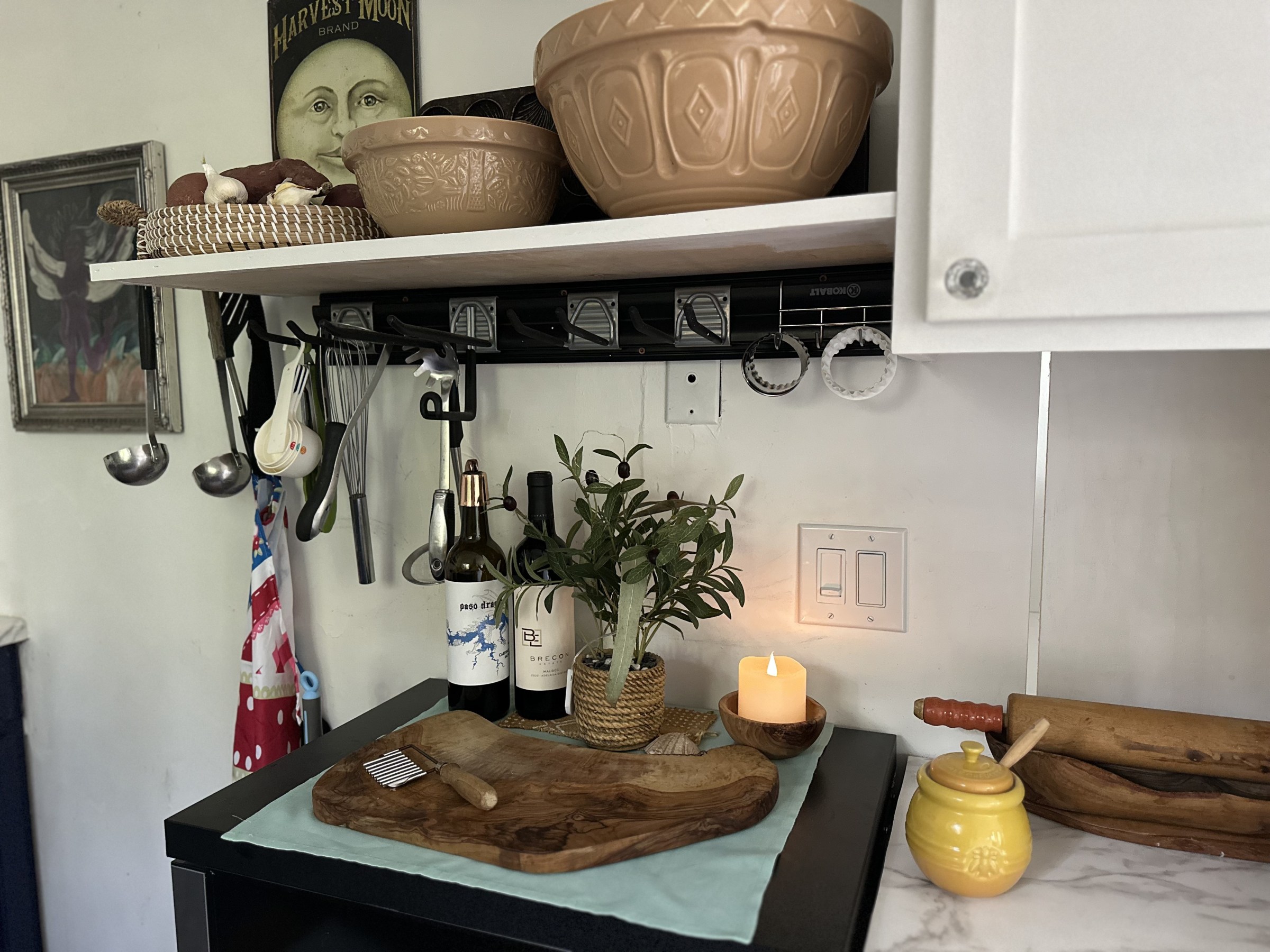
Mind you, I’m not a hermit. I chat with neighbors, my friends via phone and Facetime. I communicate, constantly, checking in with family and occasionally, the news of the day. But then there’s now. I have classical music playing, a fake candle gyrating next to a glass of Paso Robles zinfandel. Earlier, I went on a silent walk around the hilly neighborhood and acknowledged that I was still full from a late yogurt, apple and walnut lunch and would probably skip dinner. (I didn’t. Crackers, cheese and smoked salmon with a glass of wine did the trick.) When I got back from my spin around my new turf, I decided to spend a bit of time writing and reflecting and sharing my first impressions of life as a solo woman living in a studio in her favorite place on Earth.
My little castle is framed beneath my landlord’s in-need-of-new-paint ocean-view home. The backyard is spacious, wild and overgrown with a recently-dug hole, home of a future koi pond. Penny’s grand living room has been transformed into an artist’s studio with in-progress paintings filling the entirety of the main living space. Her sweet, 85-year-old mother, Kay, spends most of the time downstairs working on puzzles and watching her favorite shows. The owners’ affectionate rescue dogs spend the day chasing away curious deer and turkeys. At night, owls glide from tree to tree looking for tasty treats.
In my shrunken space, I live minimally, having grabbed a few treasures from the storage unit; some poetry books, framed pictures, two Le Creuset pans, my mom’s missing mince tart pans, a cherished golden honey pot, a 1960s Blue Chip Stamp butter yellow blender, Auntie Marjorie’s blue-eyed cat cookie jar, my American-made thick coffee shop mugs, a favorite French tablecloth, the colander my son won at a Mrs. Gooch’s raffle, a ceramic chipped tea pot sculpted by Katie and a painting Jenny gifted to me depicting a joyful purple angel dancing in a grassland of fireworks. These magical treasures seem at home in my funky tiny home, bringing me light and a connection to a life I packed up and shoved into a storage unit.
After traveling and living in a van for much of the last two years, I realize I don’t need too many things to make me happy. But I have to admit, it’s a joy to be reunited with my old friends that, to anyone else, belong in The Salvation Army’s donation bin. There’s something about sipping coffee from one of the mugs I had at my beloved old house or tossing a blanket over the couch that once graced my rocker at home that brings me delight.
Home.
I realize I can be at home almost anywhere, which is a gigantic shift and discovery for this 68-year-old grandma writer. Things are temporary.
As am I.
I do my best to embrace and enhance the places I reside, whether it’s for an afternoon or the entirety of the six-month lease I signed to be here. While I’m paused, I intend to enjoy every single literary and creative minute.
I wake up early, dance, stretch, French press my coffee, write, then go for a walk before returning to write some more. It’s the scenario I imagined since my 20s when I foolishly thought life would only be complete if I was married. Silly, 1950s sitcom me. Turns out, a lot of us mature women are realizing we aren’t characters from Disney movies dependent upon Prince Charming. We can be happy and strong sans a marital partner because what we really crave is interaction—-connection—-with interesting souls who share a mutual sense of compassion, joy and a zest for life.
Every day I fall in love, with the chorus of trees welcoming the start of a new day or the property’s rescue pup, Joy, who knocks on my door for a greeting, or a cold cup of coffee I can re-heat with this marvelous, always ready, new, non generator-powered invention—the microwave. Honestly, as a van lifer, such simple conveniences make me giddy.
Things don’t have to be perfect; this tiny studio isn’t nor was my 100-year-old Angel Cove Cottage. Like the imperfect dwellings I’m attracted to, I too have many, many flaws, but I’m exactly who—-and where—-I’m supposed to be. Mom tried to tell me this, “In time,” she often said, her chapped, thumbless hand gently tapping my knee, “you’ll understand.” Her slight, welcome touch was how my reserved mother communicated love. I just didn’t know it at the time.
Mom would like it here. If she was still alive, she and I would sit on the patio with a Cadbury biscuit and a cup of Yorkshire tea and wonder why it took so long to be close. Why did it take death for us to appreciate the other? Mom would be proud of me for not giving up, for pursing a life I was afraid of pursing, the one she might have chosen had it been a different time.
On the patio, I have three faded turquoise chairs set up conversationally around my portable fire pit, one for Papa Bear, Mama Bear and Baby Bear. Think it strange? That’s OK. I want all the ghosts to know they are welcome here.
Mermaid Cove
I’m in my Enya phase—-again. A wispy, cloudy, bubbly, dream state of being.
Honestly. Honestly. Honestly.
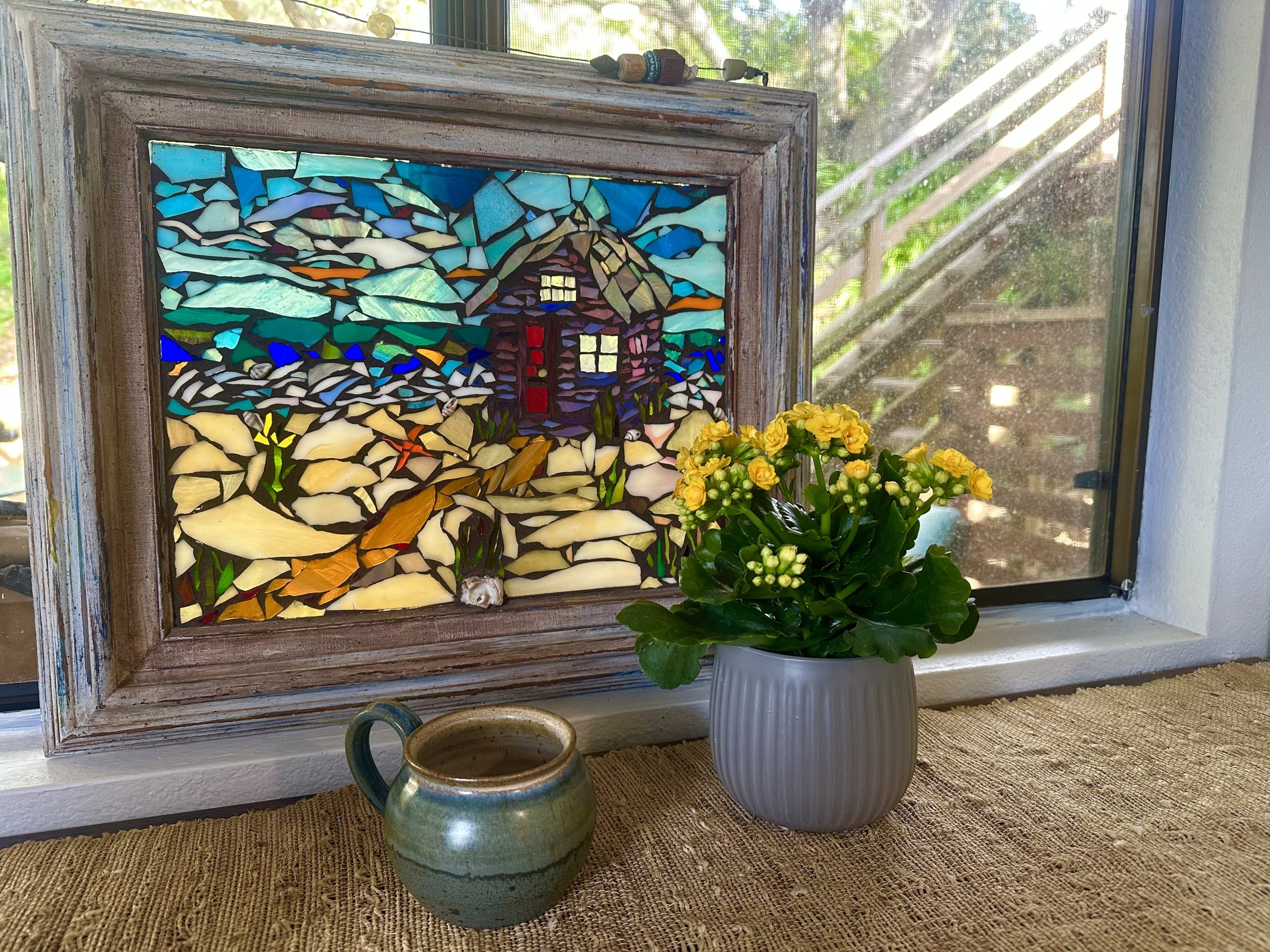
I am living my dream, a dream I’ve held onto through all, the ups and downs, the beginnings and endings and now I’m in the Now. The Now I’ve imagined in pages upon pages of journal entries. I have, at long last, a room of my very own, a studio; a bed, a small kitchen and couch, a tiny bathroom, my English china and three-tier Willow pattern afternoon tea platter Mom gifted me in my early thirties. I’m here in my Cambria, my heart, the music wrapping around my toes and threading up my spine, suspending me from the twinkling lights I have hanging above my desk. It is magical and perfect and the place I will accomplish the writing that has tangled up inside me patiently waiting to escape.
After toying with buying a place here, I decided it was wiser to lease, let my artist-landlord be responsible for big ticket items like a new roof and bad plumbing. Mermaid’s Cove, as I have christened this 600-square foot castle, will be my respite, my writers-in-residency shelter where I have vowed to finish a novel I’ve been piddling about with for a couple of years, a home where creativity will once again flourish. Here I’ll read, paint, write, of course, cook healthy meals, walk along the beach at dawn and sunset and melt into this delicious chapter of my life.
I am so immensely blessed.
Before I left the South Bay yesterday morning, I drove down Prospect Avenue, past the middle school I attended and taught at for 18 years. I said goodbye to my high school, Redondo Union, and as I approached our family home on Paulina Avenue, thought of my mom in her crisp green hospital uniform walking to work at 4:30 a.m., an hour before her shift officially started, no doubt sneaking a smoke and mapping out protocol and tasks ahead as she served her South Bay Hospital patients with pride.
All the childhood memories flooded back, trips to TG+ Y to buy Yardley’s frosted slicker lipstick and blue eye shadow—without my parents’ knowledge or permission—and counting out nickels and pennies to buy Cup of Golds and Big Hunks, destroying the evidence before getting home.
When I turned north on Paulina, I could see myself and sister in her velour striped shirt racing down the hill on our FlexiFlyers and Sears skateboards, wiping out and me and my scrapped knees vowing to never do it again.
But I did.
I could see our English setter, Major, pulling the leash to lurch at a sparrow, and Grandma Elizabeth wandering down the street months before her “forgetfulness” was diagnosed as hardening of the arteries or what we call today, dementia. When she almost set our house on fire after leaving napkins near the stove, Grandma set up new residency at a board and care facility where she died at 91.
When I stopped in front of our family home, my van packed with dusty treasures retrieved from my storage unit in Torrance, thinking of Christmas’ past, the Jackson Perkins roses my dad planted, the pond, our refuge of warmth and imagination, I realized The Paulina House is now just an abandoned-looking structure with its cold angles, its stark black and white motif, the absence of landscaping, apart from weeds. I realized it is an IT, belonging to someone else.
I puttered down the street, tears in my eyes, feeling immensely grateful that this place, this community, my family and friends, the sadness, joy, frustrations, discoveries, first boyfriend, death, new life, shaped me into the brave woman I am today. My mother, grandmother, aunties, cousin, sister, nieces, friends, my beloved dad and God, are in me, with me, as I launch this next chapter.
As I drove toward my future, filled with emotion and love, I called my son: “Remember this day, Ryan. At 68, your mom fulfilled her dream.”
It felt like a movie. Dave Matthews’ “You and Me” (one of my favorite songs) randomly clicked on and when the bane of my existence—-L.A. traffic—thinned out past Magic Mountain, an illuminated sign announced, “Fresh Start”. I’m surprised my grin didn’t break the side windows: I knew in every fiber of my being, I had made the right decision at exactly the right time in my life.
The sun is out. I am writing. I’ve already danced and taken the trash out and made a pot of coffee, hung up my wrinkled dresses, placed the china in the cupboards and am in the process of nesting. I have to run out and pick up some shelf lining and a few colorful rugs and odds and ends. I’m not sure how long I’ll be here. Other dreams await. But for now, I’m living my Josh Groban over the rainbow bucket list—check—dream.
I am home.
Princess for a week
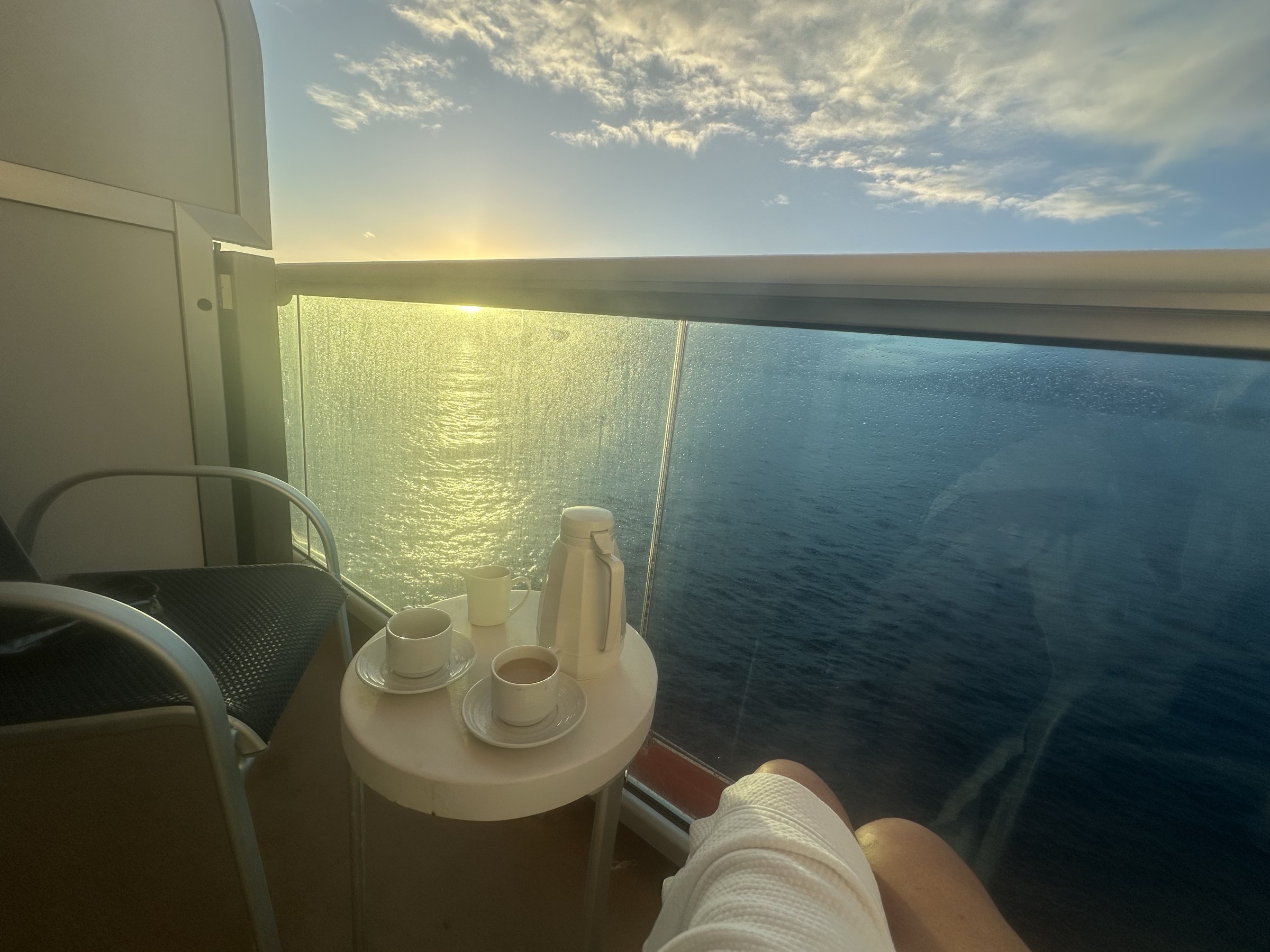
I poured my cousin’s prune juice into my coffee this morning.
The cabin was dark, and I was stunned out of a glorious sleep-in sleep by room service or a stewart (not so sure what staff is called on a giant cruise vessel). Shadowy environments like this (and yesterday’s cave-like spa room that had me accidently giving my massage therapist almost the price of the treatment in tip $) apparently makes me a generous, clumsy and gullible old person. Those who know me well know I’d never spend $100 on a beauty product but did so yesterday when the flawless-skinned therapist suggested a fancy cooling aide guaranteed to calm my arthritic lower back. I blame my uncharacteristic frivolity and fair thee wellLet It Go-attitude on Cruise Life with Friends and One Family Member in the Eastern Caribbeans, and the 15 beverage-a-day drink package.
It’s Day Three of a seven-day cruise on the Sky Princess, a massive beast of an ocean liner that feels like Las Vegas at sea. Early-to-bed, early-to-rise me was sitting at an off-Broadway-caliber rock opera last night that didn’t start until 9:30 p.m. ! Yep, the over-used exclamation point is appropriate in this case as I would never, as in NEVER, dream of rocking out at such a twilight hour, much less top off the starry night with dancing, and chatting-it-up with friends.
What’s happening to me? I’ve turned into ah one-a and a two-a, baton swinging, pop the champagne, smile at the camera, Lawrence Welk-loving Mom and Dad.
Girth and grey. That b me.
It’s crazy: Me and most of the 3,650 passengers aboard Princess’ year-old ship are generationally aligned, yet I view myself as younger, more hopeful, believing that the route ahead is bright and promising and that, if I really wanted to, I could be on that stage singing and dancing and, even though I’d suck, I secretly wish the emcee would pick me to rock out with the gorgeous, talented runners-up of The Voice cruise stars.
Maybe that’s why I agreed to sign up for today’s acupressure session with the doctor from Indian: Because I don’t want to be doomsday crunchy arthritic, pot-bellied and double-chinned anymore; I want to be Leonardo DiCaprio’s Kate Winslet as a senior citizen. When you think about it, the younger version of ourselves is still there, page 125 of a book we’re constantly writing and re-writing. Physicality is an illusion, an ever-changing version of our same selves. The good stuff, the stuff worth loving, is always there—-no matter the outside package—hopefully, being cherished and nurtured by its author. I know this to be true, yet why was I so gullible when my cousin and I went to an “educational” session about pricey collagen treatment, and there I was, my cheapskate self, ready to take out my credit card?
“I can look younger six months from now after one treatment?” where do I sign up. Thank God for my voice of reason, my cousin, who talked me down and said, “We have to research it first.”
Truth is, when I get back to “real life” I’d never do this kind of thing. Too careful with my money. So, for now, the saggy jowls are going to have to sail in the wind as aging Kate Winslet’s melting candle wax body sags across the bow into tomorrow.
Sitting here on the balcony with a drained cup of coffee, staring at the forever sea as we head to the Dominican Republic. I never, ever thought I’d vacation on a cruise ship with my beloved cousin and high school pals, Julie and Mona, and a collection of new friends. But here I am, not seasick for the first time in my life, celebrating all things joyful. Like cruise food.
So far, my cousin and I have only eaten at the buffet where they have tons of healthy food choices. That’s mostly our jam. We eat veggies and I’m pleased to report there are many, many options throughout the day. We’ve learned what we like and what to avoid, and that we dig being served and have someone prepare and clean up after us. The booze package is surprisingly easy to resist because we’re not big fans of getting drunk. We’ve discovered we’re picky about the alcohol we consume: Turns out we’ve become wine snobs and upgrade our beverages to higher quality selections. We also figured out that ultra-sweet drinks leave us lethargic. So, we drink lots of water in between tipsy-producing beverages. I guess one of the perks of getting older is you realize is getting wasted wastes the next day and we don’t have nearly enough next days to waste.
We’re out at sea today which means complete relaxation—reading, a snooze at some point, and a dip in the pool and hot tub. Not a bad way to spend Taco Tuesday, or is it Wednesday or Monday or is this all just a dream?
Today’s wish, besides the wish I’m living, is to see a whale and/or jumping dolphins. If I keep looking, I’m sure they’re out there. Just like this crazy, wonderful life I’m living, a life I dreamed of, yet never actually thought I’d experience. The Adventure of Today, no matter where I am or what I’m doing, is pretty spectacular, minus the prune juice creamer.
Today, she is free
Love is …
Remember that 1970s back-of-the-newspaper, black and white simple line-drawn “cartoon”?
That’s what I’m thinking about while I’m thinking about the trauma of the last week and the national politics of the forthcoming.
What is love? And how can love sustain us during dark and unpredictable times?
The Future on this cloudless sky Monday along Central California’s coast is stingy, crusty-eyed, headache-swollen, sucky, but we know how the Hallmark slogan goes, “It will get better.” Of course—it might. Out of ashes, you know the cliché. But today, while there’s certainly hope and all the fairy dust quotes-of-the-day, The Future seems uncertain. Our hearts are heavy, bruised, bloody, and if it weren’t for Dry January, we might very well be sitting at a bar drowning our sorrows. … At least those of us who live in heavy-heart Southern California. … At least those of us who care about the environment and how we’ve ignored the naysayer warnings. … At least those of us who don’t eat animals, pick up trash around the campground, try to avoid non-essential buying, drive only when necessary, eat mostly the entirety of the food we buy, heeding our mother’s warning—-waste not, want not.
But today, less than a week after the fires were most likely set by some looney toon, politically-inspired arsonist here in Southern California, life doesn’t feel like Annie the Musical.
Especially today.
A few hours ago, my dog died.
She outlived her vet’s predictions by about 16 months. She stood up, peed, ate breakfast, nuzzled with her dad, stumbled on her way back to her cozy bed and fell asleep forever.
I’ve been crying for a while now. Grief and gratitude are the opposite of numbing. You feel everything and long to talk it out with someone who understands, then flip to leave me alone, I need to work this out by myself.
That’s where I’m at.
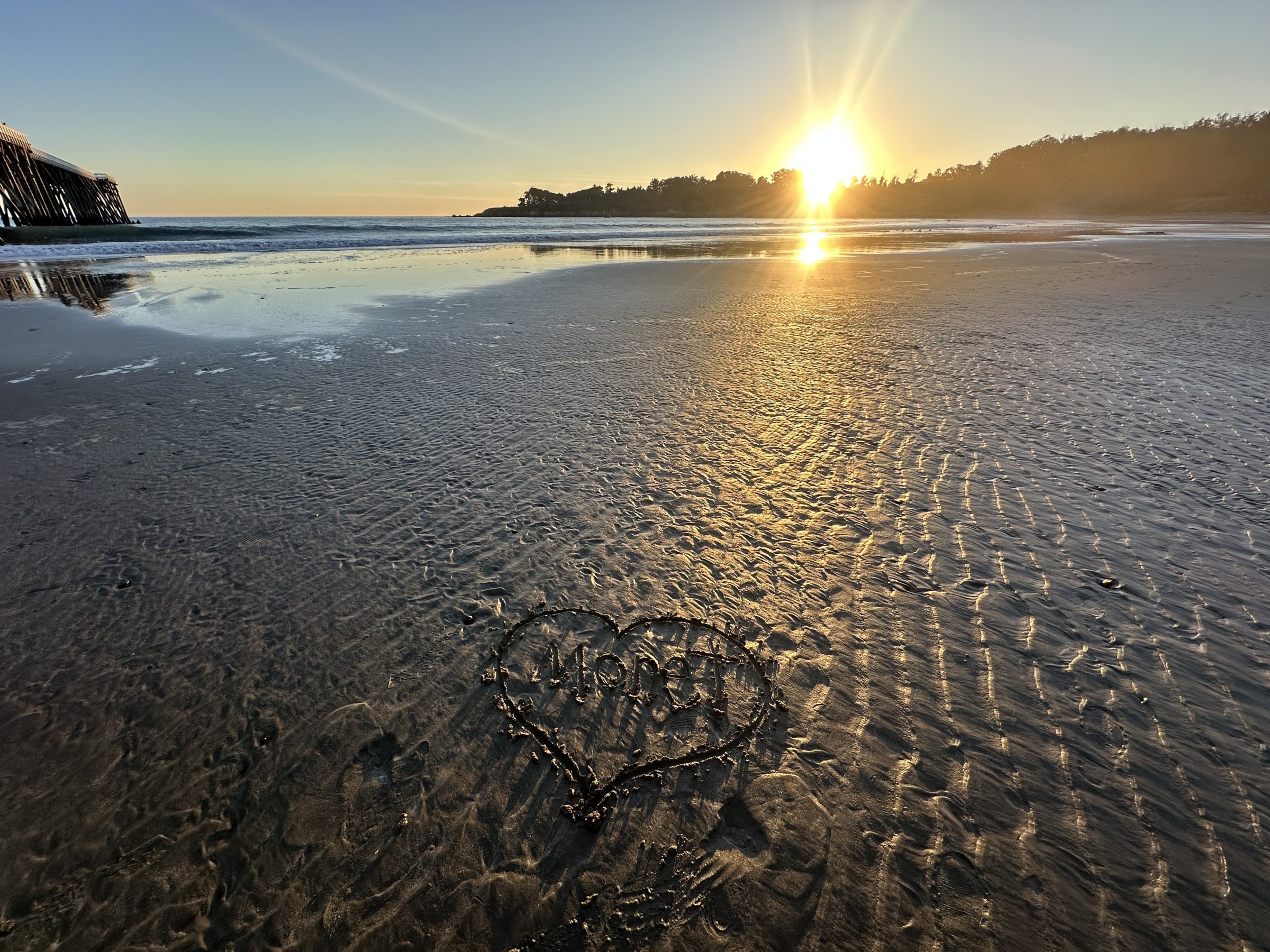
Yet, I need to tell you about my lost girl, Monet.
Born into a litter of pups destined to be Temecula meth guard dogs, she was rescued by Cary Grant’s former daughter-in-law, and adopted by us 16 years ago following the early death of our white lab, Bailey. To look at this poorly photographed misfit on the website, honestly, she looked like trouble. Freckled with Dalmatian black spots and A-frame ears the color of soot, her given name was Cookie, and she looked like a dog who sifted through trash heaps. But my youngest daughter was insistent that we didn’t allow first impressions to negate a possible match.
I was skeptical when she came to our beachside home and fully rehearsed ways to say, “No way,” but when the rescue concierge placed her in my arms, I instantly knew we meant to be together. The next day, when she jumped into our lily pond and her tail dipped into the water bowl, she was christened an esteemed name, Monet. She had an artist’s soul.
Monet was fiercely loyal, to a point that not everyone understood her and her growling protective teeth and snarling bark. She was a Blue Heeler, a cattle dog, whose DNA made her smart, tenacious, keenly sensitive of her surroundings and those who wished to do us harm, supremely coachable and a whole bunch of fun. Her herding instincts were natural and we were so proud of her athleticism at the beach, dog park, wherever we’d unleash her, “Go Monet, Go!”
She was healthy her entire life up until the moment the vet, here in Cambria, discovered tumors in her internal organs. Her prognosis wasn’t good and the vet gave her just a few months to live or a few more if she had surgery which, she said, was risky. I didn’t want to put her through the ordeal and elected not to have surgery, especially since she was nervous around strangers. Monet trusted few people. On top of her most-trusted list were my ex-husband, Bruce, myself, and our grandson, Bronson, who understood and loved her quirky, sometimes scary, mannerisms.
I dread calling him this afternoon and telling him the news.
So here I sit, with the grief, with the love, with my art materials, in the sun, overlooking the ocean, far away from the embers, far away from the apartment where she was given the injection that sent her to heaven, with my heart heavy, with my life, filled with the wisdom of Monet.
Our beloved dog taught us to live in the moment. Be there for each other. Push through it, no matter how grueling and painful it may be. Have a purpose. That last one, I’m convinced that’s why Monet lived long past her vet’s predictions. Every day she woke up with pain, but she set that aside to serve her person, Bruce.
In August 2023, when it was clear Monet was no longer well enough to accompany me on my vanlife travels, Bruce, whose left leg was amputated, welcomed our girl into his pet-friendly apartment. She hadn’t lived with him or seen him for a year as his housing situation was uncertain, but the two of them picked up where they left off—best, best buddies. Long before I sold my house and Bruce and I went our separate ways, Monet favored him. He stayed at home while I worked, and they were the best of friends. Then, as he recovered and she coped with her physical limitations, they became each other’s reason for getting up in the morning, taking a walk, socializing, planning out the day with each other’s needs in mind.
The only reason I had the heart to leave her and travel is that I knew she’d be safe and loved.
Without any agenda, Monet nudged Bruce toward mental and physical health, got him out of his depression, his wheelchair, and literally back on his right foot and left prosthetic. As recently as yesterday, the two of them went on a short walk down the hallway to greet fellow dog-loving neighbors. Bruce and Monet had a purpose.
Yesterday, while she rested and was in a coma-like trance, we Face Timed for the last time: I told her how much I loved her and all the tearful things you say to a parting loved one. But it was Bruce who gave her her last cuddle and told her, “It’s OK, Monet, you can go. I’ll be fine.”
As the home vet injected morphine into Monet, placing her into a calm and peaceful state of being, I walked along her favorite beach, we dubbed “Monet’s Beach”, thanking God, asking Him to cuddle her and reassure her that we’ll all be together again one day, and expressed gratitude for 16 years of love.
Being at our favorite place, watching the waves, hearing the seagulls, feeling the warmth of the sun on a chilly morning, I knew I’d get a sign that she passed. As I gazed at the azure sea, imagining Monet leap into the foam, a fawn-colored dog walked up to me, nuzzled my right hand, looked up, then nudged me to pet her around the ears like I used to do to Monet.
“I am here,” whispered Monet, “I will always be here.”
Today, as the angels lifted our girl into the cloudless sky, our dear Monet shed her new red collar, her matching leash and the pain that once inhabited her ailing, restrictive body, then just like the seagulls she was fond of chasing, our sweet girl spread her wings and returned to where it all began.

